Introduction
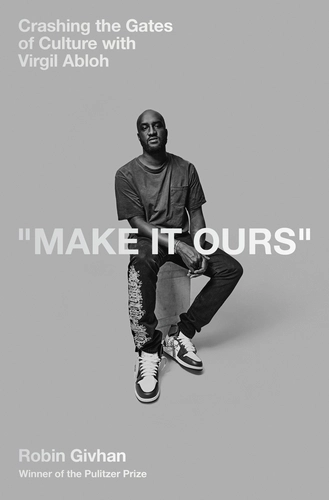
Make It Ours by Robin Givhan is a book about Virgil Abloh, his life and work. I could not help myself but reading it through the lens of a cultural shift regarding artificial intelligence that we are witnessing. I took away quite a few things from the book that are relevant to me in that regard.
My main takeaway is seeing Abloh as a strategist who reverse-engineered fashion through sampling and collaboration. Marketing and branding where his real craft Relentlessly traveling between continents he was always on the move. And all that while staying humble, no matter the stage of his career. Digitally fluent and wielding Social Media platforms for signaling and presentation he was an influencer with dexterity who could harness his followers as a powerful tool, lending him clout1 to achieve things he couldn’t have with a smaller audience.
Abloh ascended fashion’s white-credentialed luxury establishment by reverse-engineering the industry at the precise moment fashion was questioning its own reason to exist. With this he set the blueprint and a precedent for fashion houses working more with pop culture icons that seem more apt at shaping the market’s desire than the actual craft. But what if exactly this was their actual craft?
Since Abloh really fused together brand creation, branding strategy and marketing I could not help myself but reading large sections of the biography through the lens of a career manual for creatives. Especially in regard to artificial intelligence. His playbook is what designers will need when the bricklaying work is automated away.
I think in todays environment where authenticity as a virtue is challenged by the rise of machines, signaling and curation are becoming more important again.
But there is also a tension in this review that I can not yet resolve satisfyingly. Givhan’s book is fundamentally about race, gatekeeping, and what counts as luxury when the consumer base changes and the demographic demarcation lines begin to shift. By only focusing on arguments of self-improvement and career progression I left out a large and important part of what this book is about.
The race argument is noted, but deferred. Cited, called important, but ultimately sidestepped, incriminating myself in doing so.
I will try to deepen this topic in the future, but for now please bear with me.
Reverse-Engineering fashion: Done is better than perfect
“Abloh reverse engineered fashion. He created a brand and the products followed. He didn’t allow himself to be bogged down striving for perfection.”2
With this approach, Virgil Abloh made clear that he already had outlined a clear vision for what he wanted to create and that the main focus was creating his brand before product by ideating Off White first and letting the products follow. His approach was a tongue in cheek project referencing influences and objects he admired by transforming them just enough so that they could supposedly stand on their own.34 He made liberal use of the sampling and remix logic from hiphop sample culture.
To achieve that he worked in a kind of en-passant way that was a little quick and dirty and focused more on done is better than perfect. Getting it out of the door as quickly as possible, because the next idea was already waiting in the wings.
He was a frantic designer, always on the go, always driven by the tensions in his life and using that as a fuel propelling him forward.
In an age where the cost of producing an object collapses, the scarce work is what Abloh was already doing: building the frame the object arrives into. brand before product stops being a fashion-world inversion and becomes the default operating mode: decide what the work means before you decide what it is. done is better than perfect reads differently too - not a productivity slogan but a way of staying in motion when the marginal cost of another iteration is near zero. The en-passant method is the through-line: keep shipping, keep referencing, let the next idea pull you off the current one. That way you are never standing still. And it is one of my main takeaways to remember from this book.
Rewrite the playbook and going digital
During the decade that Abloh rose to the top of the fashion world, it was in an existential crisis and on a quest of searching for meaning. Fashion was defined by an Eurocentric definition of good taste from the Point of view of white men and women, were a traditional résumé meant everything. Abloh did not have any of that, and yet he rose to the top. The time was ripe for a change. And oh boy did he deliver. Fashion culture had evolved, not the least because of an influx of more and more people from diverse backgrounds rising through the ranks topped off by eponymous street culture and with it street fashion edging it’s way into the mainstream.5
One of Abloh’s main skills was riding this wave of popularity and marketing by fully embracing digital channels to create his own corner in the world.6 He was a constant communicator and communicated not only within his inner circle of friends, but out there to his fans and the people celebrating him and black fashion culture on social media.7 He was a master wielder of everything the 24/7 connectedness our devices gave us and set a precedent for this new way of working almost two decades ago, which took some getting used to for traditional companies.89 He built his world and created an aura around him by sampling and like a DJ stitching together various sources into something irresistible.10
He was without doubt a master of marketing. He played the drops playbook so thoroughly to its end that he could get genuinely large numbers of people — almost crowds — to follow him and show up to specific events. This approach meant that at events like Paris Fashion Week he drew real throngs of people to come and look at his work.
By doing this he walked around the traditional gatekeepers and by talking directly to his fans he avoided to be filtered by someone else to say things he didn’t stand for.11 His constant experimentation and sharing everything online, without hiding his process is what has drawn many people into his spell. He even created a video series discussing how anybody can start a fashion business today that is very popular on Youtube.12
Abloh’s method
Abloh created a continuous operating system to achieve his success. Sampling was his main method13. He even had this boiled down to a three percent doctrine14. What was most interesting about him was that he tied street art together with high fashion: he built a bridge between these two worlds.
For the architecture student (Abloh), […] everything was a proposition, an idea that could absorb criticism, a notion that could be improved upon in it’s next iteration.15 This was an MVP mindset of iterative thinking where he did not only publish finished pieces, but he pulled up the curtain to his atelier to show everyone who was interested into how he worked. Which he ultimately distilled into his project “Free Game”. 12
Not only that, but as a constant communicator he was always building bridges and bridging gaps between different people that all helped him to bring his Vision to life. As a notorious workaholic he was always experimenting, always iterating, constantly honing his process and refining his craft. He did not just treat his experiments as throwaway items, but as central pieces of the puzzle. When he was done with something he did not linger on it too long but was straight on to the next thing.
What makes Abloh so interesting — and why the book works so well for me — is that I’m convinced he didn’t simply do things in order to reach some specific goal. He was almost obsessed and would’ve made these things anyway, no matter what. He worked on his dream of building a fashion brand, and if it had never worked out with Louis Vuitton, he would still have become known, maybe even famous, through his work ethic alone.
And while doing that he was aware enough to keep a record of everything he did on hand, putting method to the madness.16 So other people had a chance to trace everything back to his beginnings. He always kept his portfolio intact. Maybe this was also a learning from his time as an architecture student that he was a meticulous collector of the artifacts that were produced during the process and that ultimately enabled him to have a retrospective of his work presented at a very early stage of his career in a fashion museum.
Abloh’s Vision
I cannot help myself but to read the Book about Virgil Abloh as a guide on how to survive the age of ai we are living in right now. I initially did not set out to read the book through this lens, but it kind of happened automatically, because this is a big topic resting on my shoulders nowadays. And from Abloh’s playbook a lot can be learned of how to cope, especially as a creative person that is no longer just competing with other creative people, but more and more with machines churning out creative artifacts as a commodity.
An important part that figures prominently is in the beginning of the book, is education and how important this was to Abloh’s parents. “[…] education was akin to a shield, with each degree, certification or academic award serving as an additional protective layer.”17 Additional similar sections are strewn out throughout the book18 and to me this is really fascinating, because I too think that education is important. For me it is not so much about formal education like achieving a degree to enter a certain line of work (although this might be important on an individual level and required to practice certain vocations) but more of an “ongoing education” thing. Because especially now with a topic like ai that is looming above our heads like Damocles’ Sword. Learning while doing, learning on the job and self guided learning or learning from peers are all elemental paths to take.
On top of that, having a vision to actually put this education into practice is an important quality Abloh posessed. He not only knew how to do the work, he also did it. He was a firm believer of the “Talk is cheap” paradigm and a man of action. So much so that he was almost posessed. He had a vision and followed it through.19 Communicating it visually as he went along.20 A funny sidenote is that hand sketching is talked about as a renaissance skill, but that is still growing in relevance today. Not as a tool for final delivery, but as a tool for live communication with the client, other stakeholders or the machine to generate designs and renderings that are based off of those drawings.
To me this is an important distinction. Inspite of all this technology we are closing the circle and are going back to basics. Instead of moving through a myriad of small, overcrowded UI screens á la Minority Report we are finally communicating with our machines by just using words and sketches, making the actual idea more important again.
And even if Abloh was not the finest sartorialist, he was quite apt with a pencil, knew how to present21 and knew how to create mockups and prototypes to a good standard. And then to market the shit out of that.
All qualities that are important to prevail when the machines are coming for your job.
Soft Skills
To bring his Vision into reality Abloh made use of his people skills. He was a masterful communicator and enabler who was being chided at times by none other than Kanye West for talking too much22 (Way before West drifted out into wherever he is today.) Abloh even admitted that enabling other people was one of the most satisfying aspects of his job.23
He seemed to be such a natural to it. He always had kind words for anyone, was no ass kisser and always remembered to send thank you notes. This reminds me of Aaron James Draplin who talks a lot about acknowledging the small guy, because everyone is equally important (Even so Klasse Hanno Sauer book tells otherwise.) This human level interaction is what sets us apart from the machines. And humans still like to work with other humans. Most people prefer what and who they know. And this is why being in the same room is so important from time to time. Working together live in 3d really brings collaboration to the next level. And that goes for all human relationships, not just work.
Looking back at myself I always prefer to be facilitator between different people and different functions at work myself. I thrive on finding solutions to the problems of other people. I do not know why. But just creating in a void or only for me is very hard. I need this kind of stimulation. It is like a challenge that leads me down a lot of different rabbit holes to turn up interesting ideas. In a few years, when you don’t know if you are (digitally) communicating with a machine or a human being, maybe it are exactly those human touches, das Zwischenmenschliche, and being in the room that will be the most important differentiators for bringing new ideas to fruition. Wide ranging interests also help with this, especially with the “engaging in small talk” part, but this can lead to loosing focus with too many interests (oops…).24
Robin Givhan draws a vivid portrait of Abloh. She traces back his origins and his rise to the design crown, with a large focuse on sampling. He wasn’t merely a craftsman-designer who stood out for how he sewed his garments. He was a creative mind who scored on social media, marketing and publicity, and who mastered the interpersonal so well. He could connect people with one another and was always the facilitator who made many things possible; he turned this idea of mutual cross-pollination into something big, and through it he gave his projects a hype character. He was an early acquaintance of Kanye West and always somewhere in his orbit — but I don’t think that alone is what made him famous. It does show, though, that he had already taken up collaboration and built his artistic approach out of his immediate social circle. He was an artist through and through.
Marketer or Designer?
After reading the book, I am left unsure if Abloh was a Designer or a Marketer.25 It is hard to argue with both persepectives, because both have merit. He was a good marketer, who was always able to drum up significant interest for any of his ventures among his followers. He could even do this when he was just silkscreening prints onto Ralph Lauren shirts under the Pyrex Vision moniker.26
To me, making such a distinction between marketing and design (Not in Givhan’s work, but in the design industry) misses the point. Both are important to compete in todays marketplace. The global stage is so crowded, that being a designer alone is not enough. You have to market your skills, if you want it or not. Even if it is just to find a new job. Marketing does not mean selling out.
But on the other hand, creating an image for a brand to sell something aspirational is a big part of the fashion business and why brands like Louis Vuitton are drawn to celebrities.2728 But there is still hope that in the future of the creative process, more designers with real craft and skill are offered jobs that at the moment are taken by celebrities just because of their marketing pull.29
And as Oren John said, we are living in the age of aura where a lot of people and brands are trying to create a shining halo around themselves by various means like collaboration, true collaboration that is and not just a logo swap.30
For the fashion brands it was no problem to work like this. They sure had enough craftspeople versed in the brand and actually able to bring even the wildest ideas to market. So from the brands perspective the most important element to get out of this collaboration was aura, clout and public perception. A pure marketing ploy. But without a market there is nobody buying your stuff, so it is understandable.
I believe the two sides need to go together, because you don’t become the top creative director at Louis Vuitton just by silkscreening a few T-shirts.31
Racial Tensions
Through all his life there was a racial undercurrent that has to be taken seriously, but on which I not yet feel comfortable enough to talk about. Givhan’s reporting in that regard contrasts starkly against competing accounts like the Nike Form Follows Function Vitra Museum or Shoe Dog Phil Knight, where those threads are present but very underdeveloped.
But in that telling she also leads us deeper into the racial undertones of Nike and it’s effects on urban youth from a vantage point that is less glorious than depicted in the book: Nike Form Follows Function Vitra Museum. In her telling of the sneaker-culture story she talks about the difference between the companies with mostly white shareholders and the major market segment that was Black Kids in American cities. Those kids where defining what was cool and even putting their life on the line for wearing a pair of sought after sneakers.32 Sneakers became cool, because the rising fame and status of athletes in the broader society introduced a shift in fashion. Sports fashion was no longer perceived as clothing for actually active people, but it was more and more becoming the new form of “Business Casual” or athleisure wear.33
I have to concede that I treaded too lightly on this issue weighing heavy in our current timeline. Givhan’s book is fundamentally about race and I conveniently read past it.34 35 36 37 38 But reflecting about this makes Abloh’s perseverence even more remarkable. For now I have to admit that I will have to come back to this piece once I am more informed and feel more comfortable talking about that.
Takeaways
There is always something you can do better, always room to improve. Being constantly alert on what happens around you and not waiting for permission too often is an essential ingredient for becoming better at what you do.39 The crux of being a creative person is that you are always thinking about your work. Work and life are never in balance, because you cannot stop thinking about work and so the balance is always shifting. Move fast, but do not break things.
It is important to stay grounded and well balanced as a counterweight to that struggle. A major step to achieve that is not feeling too entitled, but rather always staying kind and positive. It is an essential quality of decent human beings and being humble enough even if you move up the ladder is a sign of strength of character40.
This becomes even more impressive as you look back and not only think about Abloh and his achievements, but also about the decks he had stacked against him. As a black man in a predominantly white business it was even harder for him. And yet he excelled on merit. And he did all that while keeping true to himself, grounded and humble. This is really an achievement that cannot be highlighted enough.41
What I am left with as I finish this book is a list of ideas I will try to bring into my own workflow. While I may not have the ambition nor the skill of Virgil Abloh I got a lot of insights in what I could improve and change in my daily habits. His work ethic was what ultimately helped him achieve his dream.
But the second layer talking about the racial tensions has left me very uneasy in a few places and I have to go deeper into those aspects that are often left untouched by white authors.
I have to admit that I personally never really cared about fashion — I’m one of those people who say high fashion is absolutely not for them. But reading Robin Givhan’s book on Virgil Abloh made me think about it differently: to see high fashion not just as an affected way of dressing, but as an ambassador between generations, personalities and different scenes, where everyone has the chance to present something within a certain frame. You can’t leave that frame — your own class — but you can at least re-explore its boundaries from within, and that gave me a new perspective into the importance of fashion and with it the way of baring yourself everyday.
Abloh always stayed grounded. Everything he did has to be seen through the lens of disadvantage and discrimination, because it is that much harder for Black men to claim a place in this traditionally white-male-dominated world, which makes his achievements all the more extraordinary.
Sources
Books
Make It Ours — Robin Givhan, pages: 2, 3, 4, 5, 11, 22, 23, 31, 45, 62, 80, 82, 93, 106, 115, 120, 121, 146, 161, 168, 179, 189, 197, 201, 208, 209, 225, 246, 247, 251, 264, 273, 286, 288, 301 ↩
References
12https://free-game.virgilabloh.com ↩ ↩
Articles I am working on
3three percent doctrine ↩
6social media marketing ↩